Microsoft Office 2010 - one of the best office suite for computers, phones and browsers, including features, you can rely on today, and the opportunities that may be needed in the future. This set of applications allows you tosituation, not losing sight of the factors necessary for success in the field of information technology. For regular employees is the ability to perform daily work faster, easier and more efficient regardless of whether they are in transit or in the office, working alone or in groups. For IT professionals access to a set of intelligent tools that without too much difficulty integrating into the environment with enhanced security and work on existing equipment, ensuring business growth, rather than budget.
Year: 2010
Version: 14.0.4763.1000 VL
Platform: Windows x32/x64
Compatibility with Vista: complete
Language: English and Russian
Medicine: Present
System requirements:
* Windows XP with Service Pack 3 (SP3) (only 32-bit)
* Windows Server 2003 R2 Service Pack 2 (SP2) (32 - and 64-bit)
* Windows Server 2008 with Service Pack 1 (SP1) (32 - and 64-bit)
* Windows Vista Service Pack 1 (SP1) (32 - and 64-bit)
* Windows 7 (32 - and 64-bit)
* Windows Server 2008 R2 (64-bit)
* Windows Server 2008 with Service Pack 1 (SP1) (64-bit)
* Windows Vista Service Pack 1 (SP1) (64-bit)
* Windows 7 (64-bit)
* Windows Server 2008 R2 (64-bit)
* Processor: Pentium with a frequency of 1.0 GHz or higher.
* RAM: 512 MB.
* Hard disk: volume disk space needed depends on the parameters set.
* Screen resolution: at least 1024 x 768
Microsoft Office Professional Plus 2010:
* Microsoft Excel 2010
* Microsoft Outlook 2010 with Business Contact Manager *
* Microsoft PowerPoint 2010
* Microsoft Word 2010
* Microsoft Access 2010
* Microsoft InfoPath 2010
* Microsoft Communicator
* Microsoft Publisher 2010
* Microsoft OneNote2010
* Microsoft SharePoint Workspace 2010
* Microsoft Office applications for the Web
* Additional integrated solutions, such as support for enterprise content management (Enterprise content management, ECM), electronic forms, information law and policy
Microsoft Office Standard 2010:
* Microsoft Excel 2010
* Microsoft Outlook 2010
* Microsoft PowerPoint 2010
* Microsoft Word 2010
* Microsoft OneNote2010
* Microsoft Publisher 2010
* Microsoft Office applications for the Web
Microsoft Project Professional 2010
Microsoft Visio Premium 2010
Microsoft SharePoint Designer 2010
Monday, December 20, 2010

Thursday, December 9, 2010
Microsoft InfoPath 2010 With Custom SharePoint Integration
If you have a business which has an online presence or which you foresee to have an online presence in the recent future, learning about InfoPath might be of help while you design your collaborative web-platform. Building just portals is now passé which now seems like someone standing at a place and blowing the trumpet. It is more about information sharing and collaboration now. SharePoint 2010 is the answer to creation of such an enterprise 2.0. InfoPath empowers SharePoint usage experience.
Microsoft Office InfoPath 2007 is the defacto standard for choosing a forms designer. But the average SharePoint developer mostly reaches out to ASP.NET when he needs to create a form for SharePoint. It is surprising to note that at all those places you can employ InfoPath to even quicker form creation for enterprise management functions. Now, to take advantage of the same, clients normally want to embed InfoPath forms into a SharePoint 2007 site. There are 2 options for doing this – One, you could just create a forms library and link to the appropriate InfoPath forms. Two, you could try embedding the InfoPath 2007 form right inside SharePoint 2007. This can be done using web parts or can also be done programmatically.
With InfoPath 2010, SharePoint’s list forms can be now fully customized. You can change the look of the form, switch from single column to multi-column layouts, break the unified form into sections, validate the user-information entered, pre-populate fields, and cause certain sections of the form to show and hide automatically. After customizing the form, publishing the form back to the SharePoint site would replace the default form.
Microsoft InfoPath was released as a part of Microsoft Office 2007 to develop XML-based data entry forms. The ability to write, edit and view XML documents with one to many links among different schema was developed by InfoPath 2007. Towards the later part of 2009, Microsoft released a beta version of InfoPath which was split into two separate functionalities – InfoPath Designer and InfoPath Filler. We would focus on InfoPath 2010, on the whole, in this document.
Benefits of InfoPath 2010
• Enables Quick and Efficient Form creation.
• Helps create sophisticated and rich forms without writing code in InfoPath with just one click.
• Gives participants the ability to fill out forms online or offline.
• Helps in building modular, scalable, and portable SharePoint apps. The InfoPath Form webpart is now available too which can be used to create mashups without any coding.
• Enables embedding of the forms in SharePoint Webparts.
• Helps in connecting forms with line-of-business information and other Web Services.
• Helps in more easily managing forms on the server.
We at Mindfire Solutions have been working with SharePoint 2007 and InfoPath 2007 integration since couple of years now. After the launch of SP2010 and InfoPath 2010, we also have executed projects for global customers which needed InfoPath integration services. Using web part connections and other tricks, we can eliminate the need for massive coding which might be needed for custom form creation as well as the integration.
InfoPath is a versatile data-collection tool designed to make the creation of forms within SharePoint extremely easy, efficient, and connected to out-of-the-box or custom workflows. And yet, for IT pros and even SharePoint developers, InfoPath remains a mysterious application. Because SharePoint adoption is steadily increasing, we would like to take the opportunity to assist you more in your custom SharePoint Development needs.
Whats in store for me?
We are currently working on a few SharePoint 2010 projects which include SharePoint Migration and SharePoint development. Migrating from other technologies & older versions of SharePoint to SharePoint 2007 and SharePoint 2010 is our major strength at Mindfire Solutions. If you are looking to build a collaborative Enterprise 2.0, we can assist you in achieving your goal. Mindfire is a Microsoft Gold Certified company with its SharePoint professionals certified in Microsoft technologies. Please feel free to contact us now for your SharePoint needs.
Article Source - http://bit.ly/f4DzHU
Microsoft Office InfoPath 2007 is the defacto standard for choosing a forms designer. But the average SharePoint developer mostly reaches out to ASP.NET when he needs to create a form for SharePoint. It is surprising to note that at all those places you can employ InfoPath to even quicker form creation for enterprise management functions. Now, to take advantage of the same, clients normally want to embed InfoPath forms into a SharePoint 2007 site. There are 2 options for doing this – One, you could just create a forms library and link to the appropriate InfoPath forms. Two, you could try embedding the InfoPath 2007 form right inside SharePoint 2007. This can be done using web parts or can also be done programmatically.
With InfoPath 2010, SharePoint’s list forms can be now fully customized. You can change the look of the form, switch from single column to multi-column layouts, break the unified form into sections, validate the user-information entered, pre-populate fields, and cause certain sections of the form to show and hide automatically. After customizing the form, publishing the form back to the SharePoint site would replace the default form.
Microsoft InfoPath was released as a part of Microsoft Office 2007 to develop XML-based data entry forms. The ability to write, edit and view XML documents with one to many links among different schema was developed by InfoPath 2007. Towards the later part of 2009, Microsoft released a beta version of InfoPath which was split into two separate functionalities – InfoPath Designer and InfoPath Filler. We would focus on InfoPath 2010, on the whole, in this document.
Benefits of InfoPath 2010
• Enables Quick and Efficient Form creation.
• Helps create sophisticated and rich forms without writing code in InfoPath with just one click.
• Gives participants the ability to fill out forms online or offline.
• Helps in building modular, scalable, and portable SharePoint apps. The InfoPath Form webpart is now available too which can be used to create mashups without any coding.
• Enables embedding of the forms in SharePoint Webparts.
• Helps in connecting forms with line-of-business information and other Web Services.
• Helps in more easily managing forms on the server.
We at Mindfire Solutions have been working with SharePoint 2007 and InfoPath 2007 integration since couple of years now. After the launch of SP2010 and InfoPath 2010, we also have executed projects for global customers which needed InfoPath integration services. Using web part connections and other tricks, we can eliminate the need for massive coding which might be needed for custom form creation as well as the integration.
InfoPath is a versatile data-collection tool designed to make the creation of forms within SharePoint extremely easy, efficient, and connected to out-of-the-box or custom workflows. And yet, for IT pros and even SharePoint developers, InfoPath remains a mysterious application. Because SharePoint adoption is steadily increasing, we would like to take the opportunity to assist you more in your custom SharePoint Development needs.
Whats in store for me?
We are currently working on a few SharePoint 2010 projects which include SharePoint Migration and SharePoint development. Migrating from other technologies & older versions of SharePoint to SharePoint 2007 and SharePoint 2010 is our major strength at Mindfire Solutions. If you are looking to build a collaborative Enterprise 2.0, we can assist you in achieving your goal. Mindfire is a Microsoft Gold Certified company with its SharePoint professionals certified in Microsoft technologies. Please feel free to contact us now for your SharePoint needs.
Article Source - http://bit.ly/f4DzHU
Monday, November 29, 2010
Microsoft Office Infopath 2010 32Bit Product Key
Microsoft Office Infopath 2010 32Bit Product Key Online Activation! Never used genuine license key.
Easy to design, deploy, and use forms that work online or offline Delivers forms to the PC, phone, or browser when used with SharePoint Server 2010 Provides advanced integration capability based on industry standards Helps streamline business processes
Great for small business
Microsoft Office Infopath 2010 will take you follow benefits:
Easy to design, deploy, and use forms that work online or offline
Delivers forms to the PC, phone, or browser when used with SharePoint Server 2010
Provides advanced integration capability based on industry standards
Helps streamline business processes
Great for small business
If you have not install system the CD/DVD, Here we specifically offer you the installation system in USB which will save you half the time with the DVD installed.(4GB FLASH DRIVE)
This mean you can install Microsoft Office Infopath 2010 from a USB ( Which is much faster) installer of a CD/DVD.
Because the USB is convenience to take, You can always install, You do not worry about DVD discs ineffective can not install.But you have USB and USB anywhere that can be installed on your computer.
And our USB is a new, never used, storage capacity is 4GB, you also can use this like a hard disk.
Easy to design, deploy, and use forms that work online or offline Delivers forms to the PC, phone, or browser when used with SharePoint Server 2010 Provides advanced integration capability based on industry standards Helps streamline business processes
Great for small business
Microsoft Office Infopath 2010 will take you follow benefits:
Easy to design, deploy, and use forms that work online or offline
Delivers forms to the PC, phone, or browser when used with SharePoint Server 2010
Provides advanced integration capability based on industry standards
Helps streamline business processes
Great for small business
If you have not install system the CD/DVD, Here we specifically offer you the installation system in USB which will save you half the time with the DVD installed.(4GB FLASH DRIVE)
This mean you can install Microsoft Office Infopath 2010 from a USB ( Which is much faster) installer of a CD/DVD.
Because the USB is convenience to take, You can always install, You do not worry about DVD discs ineffective can not install.But you have USB and USB anywhere that can be installed on your computer.
And our USB is a new, never used, storage capacity is 4GB, you also can use this like a hard disk.
Thursday, November 11, 2010
Classic Menu for InfoPath 2010
Have you tried the Microsoft InfoPath 2010? If you have spent a lot of time adjusting yourself to the Ribbon interface of Microsoft InfoPath 2010, or being frustrated by searches for new features on the Ribbon interface, here is a solution to save your time for the transition, Classic Menu for Microsoft InfoPath 2010. Classic Menu for InfoPath 2010, an Office add-in designed for Microsoft InfoPath 2010, brings the menus and toolbars of InfoPath 2003 and 2007 into the Ribbon of Microsoft InfoPath 2010, adds a "Menus" tab at the far left of the menu bar and allows you to work with InfoPath 2010 as if it were InfoPath 2003/2007.

All classic menu items of InfoPath 2003 and 2007 are well displayed as a group in the tool bar of the Ribbon, while all new features and commands of Microsoft InfoPath 2010 are added to the classic style interface. The software allows you to work with InfoPath 2010 as if it were InfoPath 2003/2007. It shows the familiar classic menus and toolbars on the ribbon in Microsoft InfoPath 2010. If you were using InfoPath 2007/2003/XP/2000 before, you don't need any trainings or tutorials after upgrading to Microsoft InfoPath 2010 with this add-in now.
The software supports all languages that are supported by Microsoft InfoPath 2010: English, French, German, Italian, Spanish, Portuguese, Japanese, Dutch, Chinese, and more. It automatically shows the menus and toolbars in the language of your Microsoft Office 2010. Fully compatible with Windows 7, Windows 7 x64, Vista, Vista x64, XP, XP x64, Windows 2003 Server and 2008 Server. You can enable or disable the classic menu and toolbar in an easy way. And the Classic Menu Manage center can help you quickly configure the setting. Easy install and uninstall. Easy to show or hide tabs of Ribbon. The InfoPath 2007 build-in tabs and groups on the ribbon are available at all times. The Classic Menu for Microsoft InfoPath 2010 is very stable and strong.
All classic menu items of InfoPath 2003 and 2007 are well displayed as a group in the tool bar of the Ribbon, while all new features and commands of Microsoft InfoPath 2010 are added to the classic style interface. The software allows you to work with InfoPath 2010 as if it were InfoPath 2003/2007. It shows the familiar classic menus and toolbars on the ribbon in Microsoft InfoPath 2010. If you were using InfoPath 2007/2003/XP/2000 before, you don't need any trainings or tutorials after upgrading to Microsoft InfoPath 2010 with this add-in now.
The software supports all languages that are supported by Microsoft InfoPath 2010: English, French, German, Italian, Spanish, Portuguese, Japanese, Dutch, Chinese, and more. It automatically shows the menus and toolbars in the language of your Microsoft Office 2010. Fully compatible with Windows 7, Windows 7 x64, Vista, Vista x64, XP, XP x64, Windows 2003 Server and 2008 Server. You can enable or disable the classic menu and toolbar in an easy way. And the Classic Menu Manage center can help you quickly configure the setting. Easy install and uninstall. Easy to show or hide tabs of Ribbon. The InfoPath 2007 build-in tabs and groups on the ribbon are available at all times. The Classic Menu for Microsoft InfoPath 2010 is very stable and strong.
Monday, October 11, 2010
What’s New in InfoPath 2010
With the upcoming releases of SharePoint 2010 and Microsoft Office 2010, a new version of InfoPath will also be released. InfoPath 2007 included some minor enhancements over 2003 but did not get the Office 2007 user interface (UI) or ribbon bar. With InfoPath 2010, Microsoft has fully integrated InfoPath into the Office UI, as well as added relevant new features.
The overall goal of InfoPath 2010 is to make it much easier to create rich forms; web forms and client forms. Big investments have been made to make it simpler to build rich forms-based applications on top of the SharePoint Server 2010 platform. Here are some highlights of what you can expect from InfoPath 2010:
Quickly Design Forms with Easy-to-Use Tools
InfoPath ships with many new out-of-the box templates and includes a new rules management interface. Finally, no more clicking OK 500 times just to complete the addition of a new rule.
Layout Forms Using Pre-built Page and Section Layouts
Insert a pre-built page layout to give your form structure. Then, insert some section layouts into the page layout to start building your form.
New and Improved Controls
Some new controls have been added and the feature gap between client and browser forms has been narrowed for a more consistent user experience. New controls in InfoPath 2010 include:
* Picture buttons – Instead of the default gray button, use any image as a button in your form
* Hyperlink capabilities – Allow users to insert their own hyperlinks when filling out forms
* Date and time picker – Allow users to insert dates and times in their form
* Person/Group pickers – This control has been updated and is included by default in the Controls gallery
* Signature Line (Editor Only) – Allow users to digitally sign a form
Controls and functionality that are now supported in browser forms include:
* Bulleted, numbered, and plain lists
* Multiple selection list boxes
* Combo boxes
* Choice group and sections
* Filtering functionality
Quick Rules
With the new out-of-the-box rules and improved rules management UI, you can easily add rules to validate data, format your forms, or perform other actions - without any code.
Styles
You’ve come to love styles in Microsoft Word where you can apply multiple format options, including font and color, to selected text with one click. InfoPath 2010 includes a similar formatting tool.
The overall goal of InfoPath 2010 is to make it much easier to create rich forms; web forms and client forms. Big investments have been made to make it simpler to build rich forms-based applications on top of the SharePoint Server 2010 platform. Here are some highlights of what you can expect from InfoPath 2010:
Quickly Design Forms with Easy-to-Use Tools
InfoPath ships with many new out-of-the box templates and includes a new rules management interface. Finally, no more clicking OK 500 times just to complete the addition of a new rule.
Layout Forms Using Pre-built Page and Section Layouts
Insert a pre-built page layout to give your form structure. Then, insert some section layouts into the page layout to start building your form.
New and Improved Controls
Some new controls have been added and the feature gap between client and browser forms has been narrowed for a more consistent user experience. New controls in InfoPath 2010 include:
* Picture buttons – Instead of the default gray button, use any image as a button in your form
* Hyperlink capabilities – Allow users to insert their own hyperlinks when filling out forms
* Date and time picker – Allow users to insert dates and times in their form
* Person/Group pickers – This control has been updated and is included by default in the Controls gallery
* Signature Line (Editor Only) – Allow users to digitally sign a form
Controls and functionality that are now supported in browser forms include:
* Bulleted, numbered, and plain lists
* Multiple selection list boxes
* Combo boxes
* Choice group and sections
* Filtering functionality
Quick Rules
With the new out-of-the-box rules and improved rules management UI, you can easily add rules to validate data, format your forms, or perform other actions - without any code.
Styles
You’ve come to love styles in Microsoft Word where you can apply multiple format options, including font and color, to selected text with one click. InfoPath 2010 includes a similar formatting tool.
Tuesday, September 21, 2010
What’s New in InfoPath 2010

With the upcoming releases of SharePoint 2010 and Microsoft Office 2010, a new version of InfoPath will also be released. InfoPath 2007 included some minor enhancements over 2003 but did not get the Office 2007 user interface (UI) or ribbon bar. With InfoPath 2010, Microsoft has fully integrated InfoPath into the Office UI, as well as added relevant new features.
The overall goal of InfoPath 2010 is to make it much easier to create rich forms; web forms and client forms. Big investments have been made to make it simpler to build rich forms-based applications on top of the SharePoint Server 2010 platform.
Here are some highlights of what you can expect from InfoPath 2010:
Quickly Design Forms with Easy-to-Use Tools
InfoPath ships with many new out-of-the box templates and includes a new rules management interface. Finally, no more clicking OK 500 times just to complete the addition of a new rule.
Layout Forms Using Pre-built Page and Section Layouts
Insert a pre-built page layout to give your form structure. Then, insert some section layouts into the page layout to start building your form.
New and Improved Controls
Some new controls have been added and the feature gap between client and browser forms has been narrowed for a more consistent user experience. New controls in InfoPath 2010 include:
• Picture buttons – Instead of the default gray button, use any image as a button in your form
• Hyperlink capabilities – Allow users to insert their own hyperlinks when filling out forms
• Date and time picker – Allow users to insert dates and times in their form
• Person/Group pickers – This control has been updated and is included by default in the Controls gallery
• Signature Line (Editor Only) – Allow users to digitally sign a form
Controls and functionality that are now supported in browser forms include:
• Bulleted, numbered, and plain lists
• Multiple selection list boxes
• Combo boxes
• Choice group and sections
• Filtering functionality
Quick Rules
With the new out-of-the-box rules and improved rules management UI, you can easily add rules to validate data, format your forms, or perform other actions - without any code.
Styles
You’ve come to love styles in Microsoft Word where you can apply multiple format options, including font and color, to selected text with one click. InfoPath 2010 includes a similar formatting tool.
If all of this sounds great, but you’d rather have someone else develop forms for you, please contact us – we’d be happy to help. We’re also happy to help you with your overall forms and workflow routing strategy with SharePoint if you need higher-level answers.
News Source : http://ow.ly/2HWmf
Friday, September 17, 2010
Office 2010 - Microsoft InfoPath 2010 Überblick
Office 2010 - Microsoft InfoPath 2010 Überblick
Willkommen bei InfoPath 2010, dem Tool für das Erstellen von Formularen und Erfassen von Daten, das Unternehmen hilft, ihre Geschäftsprozesse zu optimieren. InfoPath 2010 wurde für fortgeschrittene Benutzer in Unternehmen sowie für Entwickler ausgelegt, abhängig davon, welche Art einer formularbasierten Lösung in einer Organisation benötigt wird.

Fortgeschrittene Benutzer können mit InfoPath 2010 ausgereifte elektronische Formulare entwerfen, mit denen sie schnell und kosteneffektiv Daten erfassen können. Dafür brauchen sie keinen Code zu schreiben. Entwickler können mit wenig oder gar keinem Code mit den Programmen InfoPath 2010, Microsoft SharePoint Server 2010 und SharePoint Designer 2010 erweiterte Formulare für Geschäftsprozesse auf Abteilungs- und Unternehmensebene erstellen, die anwendungsübergreifend arbeiten und Abfolgen von Workflows abdecken.
Die 10 wichtigsten Vorteile von InfoPath 2010
Schnelle und Kostengünstige Erstellung von Formularen und Geringere Trainingskosten innerhalb der gewohnten Microsoft Office Benutzeroberfläche
- Erstellen Sie mithilfe der bekannten Microsoft Office Werkzeuge wie Schriftarten, Aufzählungen, Nummerierungen, Tabellen und ClipArts neue Formulare, um Unternehmensprozesse zu unter-stützen. Die bekannten Werkzeuge und Umgebung ermöglichen eine Reduzierungen der Trainingszeit bei gleichzeitiger Beschleunigung der Formularerstellung. Das Menüband, das bereits in vielen Applikationen von Office 2007 eingeführt worden ist, ist nun auch Teil von InfoPath 2010. Basierend auf ausführlichen Nutzerumfragen und Neuentwicklungen in Hard- und Software, ist das Menüband entwickelt worden, um Ihnen die Arbeit und Orientierung zu erleichtern, so dass Sie schneller bessere Ergebnisse erzielen können.
Professionelle Formulare ohne Programmierungskenntnise Erstellen
Mit InfoPath 2010 können Sie professionelle Formulare erstellen, ohne dass Sie Programmierungskenntnisse besitzen müssen, beispielsweise können Sie:
- Schnelle Formulare erstellen und verbreiten, indem Sie das verbesserte Regel Management, die Quick Rules, Stile und dynamische Layouts verwenden.
- Stellen Sie Regeln für bedingte Formatierungen auf.
- Erstellen Sie Formulare mit Funktionen wie Benach-richtigung, Berechnungen und Datenüberprüfung.
Geben sie Nutzern die Möglichkeit Formulare Online und Offline mit Sharepoint Workspace auszufüllen
- Mit InfoPath 2010 können Formulare durch die Integration in SharePoint Workspace online und offline ausgefüllt werden. Ein Nutzer kann einfach eine SharePoint Bibliothek mit InfoPath Formularen offline in die SharePoint Workspace Umgebung übertragen. Eingegebene Informationen in den Formularen werden automatisch mit der SharePoint Bibliothek synchronisiert, sobald man wieder online ist. So kann produktiver gearbeitet werden, unabhängig davon, ob eine Verbindung zu einem Netzwerk besteht oder nicht.
Entwickeln Sie Modulhafte, Erweiterbare und Portable Sharepoint Applikationen
- Nutzen Sie SharePoint Server 2010 und InfoPath 2010, um SharePoint Applikationen zu entwickeln. Für den Gebrauch in den eigenen Abteilungen oder im Unternehmen können SharePoint Applikationen mit wenig oder gar keinen Programmierungskenntnissen erzeugt werden. Diese Lösungen sind modulhaft, d. h. sie können aus existierenden Listen oder Bibliotheken erstellt werden. Sie sind erweiterbar, d. h. mit Programmierungscodes können weitere Funktionen hinzugefügt werden. Und sie sind portabel, d. h. sie können im .wsp Format veröffentlicht werden und von Seite zu Seite oder Server zu Server verschoben werden.
Browserformulare Standardisieren
- InfoPath 2010 Formulare auf SharePoint Server 2010 sind nun mit den Web Content Accessibility Guidelines 2.0 (WCAG 2.0) AA kompatibel, um einen barrierefreien Zugang zu ermöglichen. Darüber hinaus sind Formulare, die vom SharePoint Server 2010 unterstützt werden, nun vollständig XHTML 1.0 kompatibel. Fügen Sie einfach Ihrer Datenbank mit der Drag & Drop-Funktion Navigationsoptionen hinzu.
Geniessen Sie Wirkungswollere Web Browser Formulare
- Verbesserte Gleichwertigkeit zwischen den InfoPath 2010 Client und InfoPath Formularen in SharePoint Server 2010 bietet den Nutzern eine erhöhte Beständigkeit der Funktionalitäten. So sind beispielsweise folgende Funktionalitäten in beiden Umgebungen verfügbar: Aufzählungen, Nummerierungen, einfache Listen, multiple Auswahllisten, Combo Boxes Bildbedienelemente, Hyperlinks, Gruppierungs- und Auswahlmöglichkeiten sowie Filter, Datum und Zeit Kontrolle. Erledigen Sie Ihre Arbeit schneller und einfacher.
Integrierte Formulare in Webelementen
- Mit SharePoint Server 2010 ist es einfacher denn je, Formulare auf Webseiten zu veröffentlichen, indem Sie die neue InfoPath Form Web Part Funktionalität nutzen. Zuvor musste hierzu in SharePoint Server 2007 ein Code in Visual Studio geschrieben werden. Heute, ohne auch nur eine einzige Zeile eines Codes zu schreiben, können Sie einfach den InfoPath Form Web Part auf einer Webseite einfügen und so zu dem Formular verweisen.
- Sie können die Web Parts nutzen und um jede Art von InfoPath Browser Formular, das in einer SharePoint Liste oder Bibliothek veröffentlicht worden ist, erweitern. Sie können es auch mit anderen Web Parts verknüpfen, um Daten zu senden oder zu empfangen.
Erweiterte Formulare
- Obwohl Sie bereits ohne Programmieren viele Aspekte von InfoPath Formularen personalisieren und anpassen können, ist es möglich, durch Programmieren die Formulare noch zu erweitern, wenn die eingebauten Funktionen nicht in vollem Umfang Ihren Anforderungen entsprechen.
- Sie können InfoPath 2010 Formulare mit dem mitgelieferten Visual Studio Tools for Applications (VSTA) erweitern. VSTA ist eine vereinfachte Version des Visual Studio Integrated Development Environment. Sie können VSTA nutzen, um managend Codes in C# oder VB.NET. Der Code ist dann in der InfoPath Formular Vorlage (.xsn Datei) integriert.
Verbinden sie Formulare mit Line-Of-Business Informationen und Rest Web Diensten
- SharePoint Server 2010 bietet eine erweiterbare Architektur, um Zugriffsrechte auf Datenverbindungen und –systeme zu verwalten. InfoPath kann auch in Business Connectivity Services (BCS) und SharePoint Server 2010 integriert werden. BCS erweitert die Funktionalitäten von Office Applikationen und SharePoint Plattformen mit Out-of-Box-Funktionen, Diensten und Werkzeugen, die eine nahtlose Verbindung zwischen der Lösungsentwicklung und eine tiefgreifende Integration von externen Daten und Diensten ermöglichen. Außerdem unterstützt InfoPath 2010 nun die Gewinnung von XML Daten aus REST Web Diensten. Diese nutzen Eingabeparameter, die durch eine URL übermittelt worden sind. Formularentwickler können nun die URL Parameter mithilfe von Regeln dynamisch in dem InfoPath Formular ändern, um die gewünschten Daten des REST Web Dienstes zu gewinnen, ohne Codes nutzen zu müssen.
Erleichtere Verwaltung mit Line-Of-Business Informationen und Rest Web Diensten
- InfoPath Formulare können als echte Teile des SharePoint Server 2010 überwacht werden. Neue SharePoint Maintenance-Engine-Rules stellen eine korrekte Konfiguration von InfoPath Formularen sicher. Sie können die Formulare auch über Windows PowerShell, Command-Line-Shell und Scripting-Language steuern, welche in SharePoint Server 2010 enthalten sind.
Source:-http://office-blog.net/
Wednesday, August 4, 2010
Hackers Cracked Office 2010 RC to Bypass Activation without Product Key
Microsoft Office 2010 RC build 14.0.4740.1000 is available for download and testing to few invited Microsoft connect users. These users also got retail product key to activate Office 2010 RC. Usually every Microsoft product under beta testing gets leaked out in wild on torrents and warez websites. Office 2010 RC is also leaked on torrents and widely available for download.
Users may download this leaked Office 2010 RC Retail edition but can’t activate unless you have retail product key. However this time hackers are one step ahead of Microsoft, they have already managed to the bypass & crack activation of Office 2010 RC.
Only Microsoft Office 2010 Retail edition requires product key for activation but Office 2010 RC volume license key edition can be installed without product key. The volume licensing (VLK) edition of Office 2010 RC has also made its way on various torrent and warez websites.
Hackers have put together a crack which involves using files from an activated version of Office 2010 Beta in order to bypass the activation process of Office 2010 RC. Interestingly crack, the illegal bypass method works by simply swapping two files (tokens.dat and pkeyconfig-office.xrm-ms) which sounds quite easy to do.
Another method to bypass Office 2010 RC activation involves running one script named “ActivateOffice2010beta.7z” made by one of hacker SoLoR and executing series of complicated steps.
As of now we have seen multiple forums and websites listing complete steps to bypass Office 2010 activation and Office 2010 crack is also made available for download.
The Microsoft Office 2010 activation crack is likely able to crack and activate Office 2010 RTM build. As the method has been revealed, it’s likely that Microsoft will fix the loophole before releasing the final RTM version of Office 2010. But who knows hackers may be getting ready with some other crack or activation bypass method for Office 2010.
We definitely want you to stay away from such piracy and illegal activities, always buy genuine Microsoft products and enjoy pleasure of having original stuff.
Source:- http://www.blogsdna.com
Users may download this leaked Office 2010 RC Retail edition but can’t activate unless you have retail product key. However this time hackers are one step ahead of Microsoft, they have already managed to the bypass & crack activation of Office 2010 RC.
Only Microsoft Office 2010 Retail edition requires product key for activation but Office 2010 RC volume license key edition can be installed without product key. The volume licensing (VLK) edition of Office 2010 RC has also made its way on various torrent and warez websites.
Hackers have put together a crack which involves using files from an activated version of Office 2010 Beta in order to bypass the activation process of Office 2010 RC. Interestingly crack, the illegal bypass method works by simply swapping two files (tokens.dat and pkeyconfig-office.xrm-ms) which sounds quite easy to do.
Another method to bypass Office 2010 RC activation involves running one script named “ActivateOffice2010beta.7z” made by one of hacker SoLoR and executing series of complicated steps.
As of now we have seen multiple forums and websites listing complete steps to bypass Office 2010 activation and Office 2010 crack is also made available for download.
The Microsoft Office 2010 activation crack is likely able to crack and activate Office 2010 RTM build. As the method has been revealed, it’s likely that Microsoft will fix the loophole before releasing the final RTM version of Office 2010. But who knows hackers may be getting ready with some other crack or activation bypass method for Office 2010.
We definitely want you to stay away from such piracy and illegal activities, always buy genuine Microsoft products and enjoy pleasure of having original stuff.
Source:- http://www.blogsdna.com
Wednesday, July 28, 2010
10 Best New Features in Microsoft Infopath 2010
Microsoft InfoPath 2010 allows great features to address the data quality issues. It has been designed to make information gathering more efficient by delivering electronic forms that reach the necessary participants easily, reduce redundant data entry and improve the quality of data collected. Infopath 2010 features fluent user interface that allows the creation of powerful, interactive forms, without having to write any code. Office users can customize SharePoint list forms and add custom layouts and rules to validate the data with just a few clicks and take them offline in Sharepoint Workspace. Professionals can create custom forms for document workflows and Office Business Applications that include managed code, digital signatures and connect to line of business data.
1. Quickly design forms with easy to use tools
Features to help you create quickly and easily create forms include our new Fluent UI, out-of-the-box rules, improved rules management, pre-built layout sections, and varied styles. The New tab in the Designer Backstage allows you with the available form templates that you can choose from. The majority of templates start with the default layout table.

2. Pre-built page and sections layouts for more attractive forms
Laying out the form and making it more attractive is easier than ever. You can insert a pre-built page layout to get a form structure. Insert some sections of the layout into the page layout and try building your form.

3. New and Improved controls
Infopath 2010 adds a number of new controls
- Picture buttons
- Hyperlink capabilities
- Date and time picker
- Person/Group pickers – Updated
- Signature Line (Editor Only)
There are new supports in browser control
- Bulleted, numbered, and plain lists
- Multiple selection list boxes
- Combo boxes
- Choice group and sections
- Filtering
4. Adding new rules to your Forms
Infopath 2010 features new out-of-box rules or quick rules and improved rules management UI. With the quick rules you might easily add rules to validate data, format your form, perform other actions with just a couple of clicks and without any code.

5. Create SharePoint applications
Using Infopath 2010, SharePoint Server 2010, and SharePoint Designer 2010 you can easily create useful powerful team, departmental or enterpriseapplications. Three types of application that can be developed are
Form-based application
Infopath forms can be integrated with components such as workflow reporting and custom Webpages to create rich form-based applications
Document Workflow
Infopath can be used to design custom workflow initiation and task forms that drive document management processes
Business Connectivity Services
By integrating with BCS you can design InfoPath forms that create, read, update and delete business data from a back-end system.
6. Create forms for SharePoint lists
In InfoPath you can extend as well as enhance the forms that you use for creating, editing and viewing items in a SharePoint list. To customize the form simply navigate to a SharePoint list and on the SharePoint Ribbon under List Tools, choose the Customize Form option. This would automatically generate a form that appears quite similar to the default out-of-box SharePoint list form.

You can easily customize and enhance this form by modifying the layout, creating additional views or pages, adding rules to validate your data, show or hide sections of the form or set a fields value.
7. Publish Forms Quickly
With the new quick publish feature you can publish forms in a single click. In the previous version, it required clicking through the Publishing Wizard every time you wanted to make an update the forms.
8. Creating InfoPath Form Web Part
Infopath 2010 allows you to host your InfoPath browser forms in Webpages by simply adding the InfoPath Form Web Part page. You can also connect it to other Web Parts on the page to send or receive data.
9. InfoPath Editor
InfoPath 2010 Editor features a fluent user interface and provides an enhanced, simpler user experience for filling out forms.

10. InfoPath Forms Service Administration and Management
Applying the Visual Studio Tools for Applications you might add manged code to the forms.
Source:- http://blog.taragana.com
Tuesday, July 27, 2010
Microsoft Office 2010 Deployment Tools Availability
The last couple of weeks have brought the release of tools (4 tools in 2 weeks!) to help IT Professionals expedite Office 2010 deployment. This posts highlights those four newly released tools and provides links to get started learning about using them. Respectively, these tools help you assess and plan for an Office 2010 deployment, assess potential Office application compatibility issues, and customize your Office 2010 deployment.
1. Microsoft Assessment & Planning Toolkit 5.0 (MAP)
MAP is an assessment and planning tool targeted at IT Professionals to help them begin the deployment process. The tool inventories your current environment and assesses the readiness of those computers for migration to the new technology, in this case Office 2010. MAP is an agentless tool, this means it can discover the computers in your network without installing any components on the target computers. MAP uses technologies already available in your IT environment to perform inventory and assessments. These technologies include Windows Management Instrumentation (WMI), the Remote Registry Service, Active Directory Domain Services, and the Computer Browser service. You can explore all of the capabilities of MAP on the MAP website.
We previously posted about the beta availability of the MAP 5.0 toolkit here. Thanks to community feedback we were able to improve the tool to provide an improved assessment proposal and report. You can have a quick view of the sample Office 2010 readiness reports here: Office 2010 Summary Proposal Sample, Office 2010 Assessment Report Sample
2. Office Environment Assessment Tool (OEAT)
OEAT scans client computers for add-ins and applications that interact with Office 97, Office 2000, Office XP, Office 2003, the 2007 Office system, and Office 2010. The tool is designed to be used by IT Pros who are assessing application compatibility as part of their Office 2010 migration planning. The tool now incorporates functionality to compare the discovered add-ins and applications against the list of add-ins that are pledged to be compatible by ISVs who submit them to the Microsoft Independent Software Vendor (ISV) Application Compatibility Visibility Program. OEAT compares the vendor name, product name, and version name and reports the results as partial or exact matches in the summary report spreadsheet. For more information, see the Microsoft Office Environment Assessment Tool user's guide in the technical library.
3. Office 2010 Code Compatibility Inspector (OCCI)
OCCI is an add-in developers can use in Microsoft Excel 2010, Microsoft PowerPoint 2010, Microsoft Word 2010, and Microsoft Visual Studio 2008 to troubleshoot and resolve potential issues with Microsoft Visual Basic for Application (VBA) Macros and add-ins. The tool helps guide a developer in remediating issues in VBA code to expedite migration to Office 2010. The tool scans code in a project for known compatibility issues, and then notifies you if it finds items in the code from the object model that have changed in some way or have been removed. For more information, see the Microsoft Office Code Compatibility Inspector user's guide in the technical library.
4. Microsoft Deployment Toolkit 2010 Update 1
MDT 2010 offers a great way to package Office 2010 and expose the Office Customization Tool and Office config.xml settings for easy manipulation. IT Pros can use this tool to build a complete desktop deployment package including Office 2010. You can see a complete example of how to utilize MDT 2010 to deploy Office 2010 in this blog post on the Springboard Series Blog. Get MDT 2010 Update 1 now and get started using MDT 2010 to build a complete deployment package. See the full description of the MDT 2010 update 1 here.
If you are looking for a way to see the tools in action we have a proof of concept kit to help you get started. The PoC Jumpstart is designed to help demystify the process of desktop deployment that delivers Office 2010, Windows 7 Enterprise, Internet Explorer 8, & Application Virtualization (App-V) in a controlled environment. The tools above, and others, are featured in the Microsoft Proof of Concept Jumpstart kit to help you quickly experience a complete desktop deployment. Explore the PoC Jumpstart kit here on the Springboard Series site.
Source:- http://blogs.technet.com
1. Microsoft Assessment & Planning Toolkit 5.0 (MAP)
MAP is an assessment and planning tool targeted at IT Professionals to help them begin the deployment process. The tool inventories your current environment and assesses the readiness of those computers for migration to the new technology, in this case Office 2010. MAP is an agentless tool, this means it can discover the computers in your network without installing any components on the target computers. MAP uses technologies already available in your IT environment to perform inventory and assessments. These technologies include Windows Management Instrumentation (WMI), the Remote Registry Service, Active Directory Domain Services, and the Computer Browser service. You can explore all of the capabilities of MAP on the MAP website.
We previously posted about the beta availability of the MAP 5.0 toolkit here. Thanks to community feedback we were able to improve the tool to provide an improved assessment proposal and report. You can have a quick view of the sample Office 2010 readiness reports here: Office 2010 Summary Proposal Sample, Office 2010 Assessment Report Sample
2. Office Environment Assessment Tool (OEAT)
OEAT scans client computers for add-ins and applications that interact with Office 97, Office 2000, Office XP, Office 2003, the 2007 Office system, and Office 2010. The tool is designed to be used by IT Pros who are assessing application compatibility as part of their Office 2010 migration planning. The tool now incorporates functionality to compare the discovered add-ins and applications against the list of add-ins that are pledged to be compatible by ISVs who submit them to the Microsoft Independent Software Vendor (ISV) Application Compatibility Visibility Program. OEAT compares the vendor name, product name, and version name and reports the results as partial or exact matches in the summary report spreadsheet. For more information, see the Microsoft Office Environment Assessment Tool user's guide in the technical library.
3. Office 2010 Code Compatibility Inspector (OCCI)
OCCI is an add-in developers can use in Microsoft Excel 2010, Microsoft PowerPoint 2010, Microsoft Word 2010, and Microsoft Visual Studio 2008 to troubleshoot and resolve potential issues with Microsoft Visual Basic for Application (VBA) Macros and add-ins. The tool helps guide a developer in remediating issues in VBA code to expedite migration to Office 2010. The tool scans code in a project for known compatibility issues, and then notifies you if it finds items in the code from the object model that have changed in some way or have been removed. For more information, see the Microsoft Office Code Compatibility Inspector user's guide in the technical library.
4. Microsoft Deployment Toolkit 2010 Update 1
MDT 2010 offers a great way to package Office 2010 and expose the Office Customization Tool and Office config.xml settings for easy manipulation. IT Pros can use this tool to build a complete desktop deployment package including Office 2010. You can see a complete example of how to utilize MDT 2010 to deploy Office 2010 in this blog post on the Springboard Series Blog. Get MDT 2010 Update 1 now and get started using MDT 2010 to build a complete deployment package. See the full description of the MDT 2010 update 1 here.
If you are looking for a way to see the tools in action we have a proof of concept kit to help you get started. The PoC Jumpstart is designed to help demystify the process of desktop deployment that delivers Office 2010, Windows 7 Enterprise, Internet Explorer 8, & Application Virtualization (App-V) in a controlled environment. The tools above, and others, are featured in the Microsoft Proof of Concept Jumpstart kit to help you quickly experience a complete desktop deployment. Explore the PoC Jumpstart kit here on the Springboard Series site.
Source:- http://blogs.technet.com
Thursday, July 22, 2010
Microsoft InfoPath Tutorial
Use InfoPath to gather your information easily and efficiently. You can purchase InfoPath separately or part of a Microsoft Suite, such as MS Office 2007. The program enables pre-populated fields, with validation in real-time, to connect to valuable information sources. InfoPath helps MS Office users collect information in work groups by simple forms and stores the gathered information in areas you designate in MS Office.
Getting Started with Microsoft InfoPath
1. Imagine the scenario where information is required from a large number of people in a work group. The information is specific and is needed as soon as it becomes available. InfoPath enables an easy form-filling experience that is accessible from many popular web browsers, in email messages or over mobile devices. All information can be centralized simply and easily through management and control of the input. Forms can be designed using existing XML, via a SQL Server database or another ODBC data source.
After the information has been gathered from the form recipients, it can be promulgated out again rapidly via a shared web page, accessible across computing platforms.
Form designs can be shared in the group using MS SharePoint Server applications or easily designed using one of the many predesigned forms, which have been created for common business purposes, such as employee absentee requests, change orders, service requests and simple invoices. InfoPath can also be used for asset tracking.
Integrating Information Across the Work Group
2. InfoPath and MS Office enable advanced integration capabilities. InfoPath extends into other modules in the MS Office Suite, gathering information for databases, documents and many commonly accessed projects.
Because this is an advanced Microsoft tool, support for many different forms of authentication is included. Via SharePoint, the management of forms that are used on multiple platforms via multiple servers for nontrivial activity can be accommodated.
The Future of InfoPath
3. InfoPath today is being used as part of an enterprise mashup. The application lends itself particularly well to this. In a typical national sales setting, a marketing manager could see sales information on a map mashed together, and this would provide the key to the locations of most impact in a sales promotion.
An InfoPath form could be used to roll out a new promotion. The data appears in real time and everyone, anywhere can access this information to gain the best knowledge about its progress.
InfoPath was part of the MS Office 2003 Suite, and it is currently a part of MS Office 2007. It is also included in MS Office 2010. It is an integral part of all Microsoft Work Group products and will always be a valuable component in Microsoft information gathering.
Source:- Ehow
For More Detail:
Microsoft Office 2010
Microsoft Office 2010 Product Key
Getting Started with Microsoft InfoPath
1. Imagine the scenario where information is required from a large number of people in a work group. The information is specific and is needed as soon as it becomes available. InfoPath enables an easy form-filling experience that is accessible from many popular web browsers, in email messages or over mobile devices. All information can be centralized simply and easily through management and control of the input. Forms can be designed using existing XML, via a SQL Server database or another ODBC data source.
After the information has been gathered from the form recipients, it can be promulgated out again rapidly via a shared web page, accessible across computing platforms.
Form designs can be shared in the group using MS SharePoint Server applications or easily designed using one of the many predesigned forms, which have been created for common business purposes, such as employee absentee requests, change orders, service requests and simple invoices. InfoPath can also be used for asset tracking.
Integrating Information Across the Work Group
2. InfoPath and MS Office enable advanced integration capabilities. InfoPath extends into other modules in the MS Office Suite, gathering information for databases, documents and many commonly accessed projects.
Because this is an advanced Microsoft tool, support for many different forms of authentication is included. Via SharePoint, the management of forms that are used on multiple platforms via multiple servers for nontrivial activity can be accommodated.
The Future of InfoPath
3. InfoPath today is being used as part of an enterprise mashup. The application lends itself particularly well to this. In a typical national sales setting, a marketing manager could see sales information on a map mashed together, and this would provide the key to the locations of most impact in a sales promotion.
An InfoPath form could be used to roll out a new promotion. The data appears in real time and everyone, anywhere can access this information to gain the best knowledge about its progress.
InfoPath was part of the MS Office 2003 Suite, and it is currently a part of MS Office 2007. It is also included in MS Office 2010. It is an integral part of all Microsoft Work Group products and will always be a valuable component in Microsoft information gathering.
Source:- Ehow
For More Detail:
Microsoft Office 2010
Microsoft Office 2010 Product Key
Sunday, July 18, 2010
Microsoft Office 2010: The History and Reviews
Back in the 1990s, Microsoft
Back then the Office productivity suite of tools was almost universally used and widely admired (a few security exploits notwithstanding). Encouraged by the praise heaped on what was to become the most successful program of its type, Microsoft added more and more features and bulked out the number of programs and variety of editions customers could choose from. The result: too much choice and too much bloat, cried commentators.
In the days of Windows XP, a feature-laden copy of Office Professional was accused of taking up far more than its share of system resources. With less than 1GB of RAM powering the programs on the average home
Microsoft responded to the criticism by reining in Office’s intrusions. Microsoft Office 2007 saw the introduction of a ribbon menu that made it easier to get to the items related to your current task, rather than interrupting you to check that you are doing things Microsoft’s way. Intended to be a less overblown take on Office, however, the 2007 version was berated for making unnecessary alterations to a largely successful interface. Many people never upgraded from Office 2003, while plenty still use earlier versions.

With Office 2010, Microsoft hopes to find us all on the same electronic page. It’s cut back on the number of versions, with home and non-business users offered a single Office Home and Student Edition. It’s given the constituent programs in Office a uniform look (Outlook’s design lagged behind the other main programs), it’s made a concerted effort to add web-based elements into the mix and it’s allowed plenty of time for both closed beta testers and the general public to try out Office 2010’s various features and provide feedback on them.
To this end, Office 2010 has been available as a free beta download for the past six months. That’s given Microsoft plenty of time to gather valuable feedback from users about what does and doesn’t work, and to iron out any glitches that may have been uncovered.
In mid-April 2010, Microsoft announced that it had completed this process and was ready to start rolling out its office suite in time for a June launch. But the trial version was still available as we went to press, so it’s not too late to try before you buy.
As you’ll learn from our reviews over the following pages, we think many readers will want to become Microsoft Office 2010 users. Should you agree, we’ve got some advice on how to go about doing so for free or on the cheap.
Source:- pcadvisor
Thursday, July 15, 2010
MS Office Professional Plus 2010 Installation & Screenshots
If you have already downloaded MS Office Professional Plus 2010 software directly from the Microsoft website the next step would be to install it and take advantage of all its features. In this article we are going to show you with some features and screen shots of the software which are have installed and how to get started using them.
The beginning would be with the Extraction of files from the large downloaded file. Next you will find that there is a option to Upgrade because i had MS Office already installed of a older version and hence i could customize this to keep all the previous versions or else upgrade it. The installation process would start, though i felt that it took a long time to install because the progress bar was quite slow in moving and at a moment i did feel to cancel the installation.

MS Office 2010 Install
You will find a list of programs installed on your computer, in the Start>All Programs section. The following screenshot can give you a idea on this.
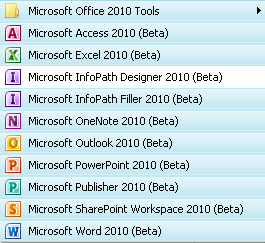
Ms Office 2010 Programs
Here are few screenshots of MS Office Word, Excel, Powerpoint & Infopath Designer.

Source:- amitbhawani.com
Wednesday, July 7, 2010
Microsoft announces Office 2010 pricing
MICROSOFT HAS CHOSEN CES week, the time when exciting announcements are usually made, to provide us with details of its Office 2010 pricing.
Yeah, no skateboarding music player mobile phone for Microsoft, rather the exciting news out of Redmond is that its Office 2010 applications suite is nearly out of beta and on release will be available in four different versions.
Micrsoft expects sales to be high. It said that in just seven weeks, more than two million people around the world have downloaded the beta version. To get a better appreciation for that number, says Rachel Bondi, general manager of Microsoft Office, "it's a rate of more than 40,000 downloads per day. That's approximately twice the number of people who run the Boston Marathon each year, or the entire population of Olympia, WA, or Annapolis, MD, downloading the Office 2010 beta every day!" Wow, two Boston Marathons. That really puts it into context.
Office 2010 will be released in four versions, Office Home and Business, Office Professional, Office Home and Student, and Office Professional Academic, and they will cost $279, $499, $149, and $99, respectively. Product key card versions are also available and cost a little less, presumably since they do not require boxing and all that other non-green stuff.
Unlike the other options, this can only be used on one machine, however, while for example the home and business, and professional editions can be installed on two.
Most interestingly however, the Vole said it will drop all discounted 'upgrade' pricing for customers who previously bought earlier versions of its Office productivity suite. This will in effect amount to a hefty price increase for a lot of users.
We imagine that this decision by Microsoft will drive more people to download the free - and interoperable with Microsoft Office - Open Document Format (ODF) alternative, Openoffice.org.
Source:- theinquirer.net
Yeah, no skateboarding music player mobile phone for Microsoft, rather the exciting news out of Redmond is that its Office 2010 applications suite is nearly out of beta and on release will be available in four different versions.
Micrsoft expects sales to be high. It said that in just seven weeks, more than two million people around the world have downloaded the beta version. To get a better appreciation for that number, says Rachel Bondi, general manager of Microsoft Office, "it's a rate of more than 40,000 downloads per day. That's approximately twice the number of people who run the Boston Marathon each year, or the entire population of Olympia, WA, or Annapolis, MD, downloading the Office 2010 beta every day!" Wow, two Boston Marathons. That really puts it into context.
Office 2010 will be released in four versions, Office Home and Business, Office Professional, Office Home and Student, and Office Professional Academic, and they will cost $279, $499, $149, and $99, respectively. Product key card versions are also available and cost a little less, presumably since they do not require boxing and all that other non-green stuff.
Unlike the other options, this can only be used on one machine, however, while for example the home and business, and professional editions can be installed on two.
Most interestingly however, the Vole said it will drop all discounted 'upgrade' pricing for customers who previously bought earlier versions of its Office productivity suite. This will in effect amount to a hefty price increase for a lot of users.
We imagine that this decision by Microsoft will drive more people to download the free - and interoperable with Microsoft Office - Open Document Format (ODF) alternative, Openoffice.org.
Source:- theinquirer.net
Tuesday, July 6, 2010
Microsoft Office 2010 Volume Product Key
Microsoft Office 2010 volume licensing customers have to activate their volume license suites using a volume license key (VLK). Microsoft made it mandatory to go through volume license activation in order to start using the volume licensed products like it did in case of Windows 7 and Windows Server 2008. Like Office 2007 and Office 2003, you have to provide a 25-characters volume license key (VLK) during installation, so that the end-users won’t have to activate it all over again using the licensed product key, they can simply bypass this step.
This drawback allows users to download pirated copies of Microsoft Office 2010 as it will require no activation using product keys. In order to tackle this issue, Microsoft is planning to stem the counterfeit Office with Office Genuine Advantage (OGA) Validation and Office Genuine Advantage Notifications, but soon hackers will develop cracks or patches to bypass OGA limitations, this does not seem to be the way to control piracy.

With the announcement and release plans of MS Office 2010, Microsoft is taking an another step to fight against hackers and crackers and it’s Software Protection Platform (SPP), which was initially implemented on operating systems like Windows Vista and Windows Server 2008. As a result, all Office 2010 license acquired through volume licensing channel has to be activated, via KMS host (Key Management Server) for local activation of more than 25 licenses, or MAK product key (Multiple Activation Key).
Microsoft Office 2010 activation method is almost similar with Windows 7 activation. You have to configure Key Management Service (KMS) host to activate Office 2010 clients. Note down the following MS Office 2010 activation tricks.
1. Key Management Service (KMS) hosts configured to activate MS Office should be installed on operating systems such as Windows Server 2003, volume editions of Windows 7 or Windows Server 2008 R2
2. If you want KMS host to activate multiple Microsoft products (e.g. Office 2010 and Windows 7), you will need to install the Windows KMS host key with Office KMS host key and activate both of them
3. Microsoft Office KMS clients are only activated when five or more than five computers with MS Office installed attempt to get activated using the KMS host. In case of operating systems (e.g. Windows Vista and Windows 7), activation starts after 25 or more than 25 computers with Windows client request for activation.
Source:- solidblogger.com
This drawback allows users to download pirated copies of Microsoft Office 2010 as it will require no activation using product keys. In order to tackle this issue, Microsoft is planning to stem the counterfeit Office with Office Genuine Advantage (OGA) Validation and Office Genuine Advantage Notifications, but soon hackers will develop cracks or patches to bypass OGA limitations, this does not seem to be the way to control piracy.
With the announcement and release plans of MS Office 2010, Microsoft is taking an another step to fight against hackers and crackers and it’s Software Protection Platform (SPP), which was initially implemented on operating systems like Windows Vista and Windows Server 2008. As a result, all Office 2010 license acquired through volume licensing channel has to be activated, via KMS host (Key Management Server) for local activation of more than 25 licenses, or MAK product key (Multiple Activation Key).
Microsoft Office 2010 activation method is almost similar with Windows 7 activation. You have to configure Key Management Service (KMS) host to activate Office 2010 clients. Note down the following MS Office 2010 activation tricks.
1. Key Management Service (KMS) hosts configured to activate MS Office should be installed on operating systems such as Windows Server 2003, volume editions of Windows 7 or Windows Server 2008 R2
2. If you want KMS host to activate multiple Microsoft products (e.g. Office 2010 and Windows 7), you will need to install the Windows KMS host key with Office KMS host key and activate both of them
3. Microsoft Office KMS clients are only activated when five or more than five computers with MS Office installed attempt to get activated using the KMS host. In case of operating systems (e.g. Windows Vista and Windows 7), activation starts after 25 or more than 25 computers with Windows client request for activation.
Source:- solidblogger.com
Wednesday, June 23, 2010
Which Office 2010 Edition Is Right For You?
MS Office 2010 Starter Edition replaces MS Works, Microsoft's former introductory-level efficiency suite. If you only need essential word-processing and spreadsheet functions, with small stare for serious desktop publishing or data analysis, then Office 2010 Starter is perhaps good enough.
Office 2010 Home and Student is departing to serve approximately everyone Office Starter Edition doesn't. Do you need macros, or pivot tables, or to create PowerPoint presentations? Then you need Office 2010 Home and Student, at the extremely least.
Do you need Microsoft Outlook 2010? Then you're going to shell out an extra $80 to $130 for Office 2010 Home and Business.
Do you need Microsoft Publisher 2010 or Access 2010? Then you need Office 2010 Professional. Be certain you can't live without those apps, because they'll cost you an extra $230 to $360 over the Home and Student Edition of Office 2010. (Unless you can qualify for the Office 2010 professional Academic discount, which is probably the best possible deal for any version of Office 2010.)
If you need Microsoft InfoPath, Communicator, or SharePoint Workspace, you'll need a TechNet or MSDN membership, or to talk to a Microsoft volume reseller. That said, these are fairly corporate-centric tools, so most households and even small businesses won't need to worry about the bells and whistles of Office 2010 Professional Plus.
Bottom Line: Stick with Office 2010 Starter Edition until you're sure you need more than it will offer. It's free and Microsoft has made upgrades extremely easy -- most of the ads in Office 2010 Starter are for full versions of Office 2010, so simply click one to begin the upgrade process. Once you've identified what Office 2010 Starter doesn't have but that you truly need, you'll be able to choose between Office 2010 Home and Student (for PowerPoint), Home and Business (for Outlook), and Professional (for Publisher and Access).
Office 2010 Home and Student is departing to serve approximately everyone Office Starter Edition doesn't. Do you need macros, or pivot tables, or to create PowerPoint presentations? Then you need Office 2010 Home and Student, at the extremely least.
Do you need Microsoft Outlook 2010? Then you're going to shell out an extra $80 to $130 for Office 2010 Home and Business.
Do you need Microsoft Publisher 2010 or Access 2010? Then you need Office 2010 Professional. Be certain you can't live without those apps, because they'll cost you an extra $230 to $360 over the Home and Student Edition of Office 2010. (Unless you can qualify for the Office 2010 professional Academic discount, which is probably the best possible deal for any version of Office 2010.)
If you need Microsoft InfoPath, Communicator, or SharePoint Workspace, you'll need a TechNet or MSDN membership, or to talk to a Microsoft volume reseller. That said, these are fairly corporate-centric tools, so most households and even small businesses won't need to worry about the bells and whistles of Office 2010 Professional Plus.
Bottom Line: Stick with Office 2010 Starter Edition until you're sure you need more than it will offer. It's free and Microsoft has made upgrades extremely easy -- most of the ads in Office 2010 Starter are for full versions of Office 2010, so simply click one to begin the upgrade process. Once you've identified what Office 2010 Starter doesn't have but that you truly need, you'll be able to choose between Office 2010 Home and Student (for PowerPoint), Home and Business (for Outlook), and Professional (for Publisher and Access).
Monday, June 14, 2010
Mictosoft Office 2010 Editions and Set-Up Information
Office editions
We reviewed MS Office 2010 Professional, which expenses a large AU$849, but happily includes the aptitude to be installed on two PCs. This group includes Word2010, Excel, PowerPoint, OneNote, Outlook, Publisher and Access, in count to SharePoint Workspace for shared tools and InfoPath exclusive for standardised forms. If you don't require desktop email, you must opt for the buck level Office, Home & Student at AU$209 for three PCs, which includes Word2010, Excel, PowerPoint and OneNote. Office 2010 Home and Business adds Outlook 2010 to the Home and Student version and costs AU$379 for two PCs. Regrettably, there is no improve pricing for Microsoft Office 2010, because Microsoft found that most people buy Office when they acquire a new computer and there was small attention in upgrades at trade outlets.
Set-up
We installed Office 2010 on two special test equipment, single successively Windows XP and the extra running Windows 7. In together cases the typical installation was rather effortless, clocking in at fewer than 20 minutes from start to end. supplies to run Office 2010 vary depending on which operating system you're running, but you'll need at the very least a 500MHz computer or higher, 256MB of RAM (512MB recommended to use more advanced features), and Windows XP with Service Pack (SP) 3 (32-bit).
Connectivity to Microsoft Exchange 2000 Server or soon is necessary for sure higher functionality in Office Outlook 2010. Immediate Search with options that appear as you type requires Windows Desktop Search 3.0. You will also require Windows Server 2003 with SP1 or afterward successively Windows SharePoint Services if you want to use the extra superior association tools. We were happy to see that Office 2010 didn't litter our desktop with new shortcut icons, leaving it up to us how we wanted to launch the suite.
We reviewed MS Office 2010 Professional, which expenses a large AU$849, but happily includes the aptitude to be installed on two PCs. This group includes Word2010, Excel, PowerPoint, OneNote, Outlook, Publisher and Access, in count to SharePoint Workspace for shared tools and InfoPath exclusive for standardised forms. If you don't require desktop email, you must opt for the buck level Office, Home & Student at AU$209 for three PCs, which includes Word2010, Excel, PowerPoint and OneNote. Office 2010 Home and Business adds Outlook 2010 to the Home and Student version and costs AU$379 for two PCs. Regrettably, there is no improve pricing for Microsoft Office 2010, because Microsoft found that most people buy Office when they acquire a new computer and there was small attention in upgrades at trade outlets.
Set-up
We installed Office 2010 on two special test equipment, single successively Windows XP and the extra running Windows 7. In together cases the typical installation was rather effortless, clocking in at fewer than 20 minutes from start to end. supplies to run Office 2010 vary depending on which operating system you're running, but you'll need at the very least a 500MHz computer or higher, 256MB of RAM (512MB recommended to use more advanced features), and Windows XP with Service Pack (SP) 3 (32-bit).
Connectivity to Microsoft Exchange 2000 Server or soon is necessary for sure higher functionality in Office Outlook 2010. Immediate Search with options that appear as you type requires Windows Desktop Search 3.0. You will also require Windows Server 2003 with SP1 or afterward successively Windows SharePoint Services if you want to use the extra superior association tools. We were happy to see that Office 2010 didn't litter our desktop with new shortcut icons, leaving it up to us how we wanted to launch the suite.
Sunday, June 6, 2010
How Can Office 2010 Help Microsoft Continue It’s Leadership?
Office 2010 suite, which was publiashed as a beta version throughout the past quarter, has been downloaded over two million times so distant and has established encouraging feedback from users.
Even though the positive reaction, we think it’s pointed for Microsoft to maintain its divide in the productivity software market due to competition from Google (NASDAQ:GOOG) and IBM (NYSE:IBM).
Microsoft Office constitutes around 30% of Microsoft’s stock
Microsoft’s Office Suite is a group of desktop applications used mainly for word processing, spreadsheet preparation, presentations, and email. The software is used by the popular of consumers and businesses, creation partnership between users easier and helping to achieve demand for the software.
We approximation that the Microsoft Office business makes up 30% of the $32 Trefis price estimate for Microsoft’s stock.
Office 2010 inadequate to stop production software market share refuse
Microsoft has subjugated the venture productivity software market in the past with market share of around 95% driven by the success of the preceding versions of its office suite. Microsoft plans to launch the latest version of Office in the second half of 2010. The software, which offers elasticity of use on the PC, browser and phone, has received positive feedback from early users.
Although the helpful initial advice for Office 2010, we think Microsoft may not be capable to continue its leadership situation in the future due to increasing competition from other industry players. The main threat is alternatives to Office such as IBM’s free office software (from its Lotus Symphony suite) and Google’s low cost Apps suite, which includes e-mail, calendar, word processing, spreadsheet and collaboration programs.
We anticipate Microsoft’s share in the Productivity Software market to decline to 89% by the end of Trefis forecast period. However, you can change our forecast here to see how Microsoft’s supply value would be impacted if the company were able to continue its share in the venture output.
Even though the positive reaction, we think it’s pointed for Microsoft to maintain its divide in the productivity software market due to competition from Google (NASDAQ:GOOG) and IBM (NYSE:IBM).
Microsoft Office constitutes around 30% of Microsoft’s stock
Microsoft’s Office Suite is a group of desktop applications used mainly for word processing, spreadsheet preparation, presentations, and email. The software is used by the popular of consumers and businesses, creation partnership between users easier and helping to achieve demand for the software.
We approximation that the Microsoft Office business makes up 30% of the $32 Trefis price estimate for Microsoft’s stock.
Office 2010 inadequate to stop production software market share refuse
Microsoft has subjugated the venture productivity software market in the past with market share of around 95% driven by the success of the preceding versions of its office suite. Microsoft plans to launch the latest version of Office in the second half of 2010. The software, which offers elasticity of use on the PC, browser and phone, has received positive feedback from early users.
Although the helpful initial advice for Office 2010, we think Microsoft may not be capable to continue its leadership situation in the future due to increasing competition from other industry players. The main threat is alternatives to Office such as IBM’s free office software (from its Lotus Symphony suite) and Google’s low cost Apps suite, which includes e-mail, calendar, word processing, spreadsheet and collaboration programs.
We anticipate Microsoft’s share in the Productivity Software market to decline to 89% by the end of Trefis forecast period. However, you can change our forecast here to see how Microsoft’s supply value would be impacted if the company were able to continue its share in the venture output.
Subscribe to:
Comments (Atom)